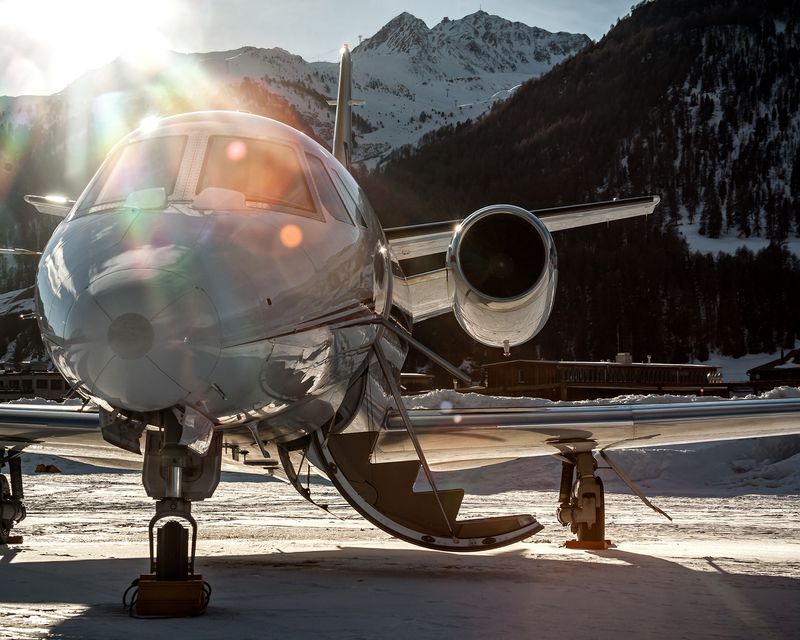

If you have ever watched a private jet climb into the sky and wondered just how quickly it gets from one city to the next, you are not alone. Private jet speed is one of the most searched topics among travelers considering charter flights, and the answer depends on the type of aircraft, its engines, and the altitude it flies at.
On average, a private jet cruises somewhere between 400 and 700 miles per hour. That is a wide range because private jets are not one single category of aircraft. A small turboprop and an ultra long range heavy jet are built for very different missions, and their speeds reflect that.
Average Private Jet Cruising Speed
Most private jets cruise at around 500 to 600 mph once they reach their operating altitude. This is already faster than many commercial airliners, which typically cruise between 460 and 575 mph. Private jets can push past this range for two main reasons.
First, they tend to fly at higher altitudes, often above 40,000 feet, where the air is thinner and offers less resistance. Second, most private jets are lighter and more aerodynamically efficient than large commercial aircraft, which allows their engines to push them through the air more quickly relative to their size.
Pilots and manufacturers often describe jet speed in Mach numbers rather than mph. Mach 1 represents the speed of sound. Most private jets cruise somewhere between Mach 0.75 and Mach 0.90, while the fastest models edge close to Mach 0.95.
Private Jet Speed by Category
Private jets are generally grouped into a few categories, and speed changes quite a bit as you move up the ladder.
Turboprops are the entry point into private aviation. These propeller driven aircraft, such as the Pilatus PC-12, typically fly between 190 and 330 mph. They are efficient and can land on shorter runways, but speed is not their main strength.
Light jets pick up the pace considerably. Aircraft like the Embraer Phenom 300 or Cessna Citation CJ4 cruise around 450 to 520 mph, making them a solid choice for short regional hops of two to three hours.
Midsize jets sit comfortably between 500 and 600 mph, offering a balance of range, cabin space, and speed for longer domestic trips.
Heavy and ultra long range jets are where things get impressive. Aircraft such as the Gulfstream G650ER, Gulfstream G700, and Bombardier Global 7500 cruise at 575 to 700 mph, closing in on the edge of the sound barrier while still carrying passengers across oceans in comfort.
The Fastest Private Jets in the World
If you want a straight answer to “what is the fastest private jet,” the current title holder is the Bombardier Global 8000. It reached the market in late 2025 and has been certified by both Transport Canada and the FAA, with European certification still pending. Its top speed is Mach 0.95, making it the fastest civilian aircraft to enter service since the Concorde retired. During flight testing, it even briefly exceeded Mach 1, although its certified operating speed remains just below the sound barrier.
Close behind it are the Gulfstream G700 and the Cessna Citation X+, both capable of around Mach 0.935, or roughly 617 mph. The Dassault Falcon 8X and Gulfstream G650ER also rank among the fastest business jets flying today, each cruising at speeds that rival or beat many commercial jetliners.
It is worth noting that these top speeds are rarely used for an entire flight. Most of these aircraft cruise at a slightly lower long range speed, usually around Mach 0.85, to save fuel and extend range. The higher Mach numbers are reserved for situations where getting somewhere quickly genuinely matters.
Private Jet Speed Vs. Commercial Airline Speed
A common question is whether private jets are actually faster than the commercial planes people fly on every day. The short answer is usually yes, but the gap is not always huge in raw cruising speed.
A Boeing 737 or Airbus A320 typically cruises around 500 to 550 mph, and a Boeing 747 cruises close to 500 mph as well. Many private jets match or exceed this, and the faster heavy jets can beat commercial airliners by well over 100 mph.
The bigger time saving with private aviation rarely comes from raw speed alone. It comes from everything around the flight. Private jets can use more direct routing, skip layovers, and depart from smaller regional airports closer to your final destination. Combine that with minimal wait times before boarding, and the total door to door travel time often ends up far shorter than a commercial flight, even when the difference in cruising speed is modest.
What Affects a Private Jet’s Actual Speed
A private jet’s listed top speed is not always what you experience on a given flight. Several real world factors come into play.
Aircraft weight matters a great deal. A jet loaded with passengers, luggage, and a full fuel tank will not accelerate or cruise quite as quickly as one flying light.
Altitude plays a major role too. Thinner air at higher altitudes reduces drag, which is why jets often climb well above 40,000 feet once they are clear of congested airspace.
Wind conditions can shift ground speed significantly. A strong tailwind can push an aircraft’s speed over the ground well beyond its normal cruising number, while a headwind has the opposite effect.
Finally, engine type and airframe design set the ceiling. Turbofan engines paired with efficient wing designs allow modern heavy jets to sustain speeds that would have been considered extraordinary just two decades ago.
Summary
So how fast is a private jet? Most cruise between 500 and 600 mph, with the fastest models like the Bombardier Global 8000 approaching 700 mph and Mach 0.95. That puts private aviation well ahead of typical commercial airliners in raw speed, and combined with fewer delays and more direct routing, the real time savings for travelers can be even greater than the numbers alone suggest.
Whether you are chartering a light jet for a quick regional trip or booking a heavy jet for an intercontinental journey, understanding these speed differences can help you set realistic expectations for flight time and choose the right aircraft for your trip.