
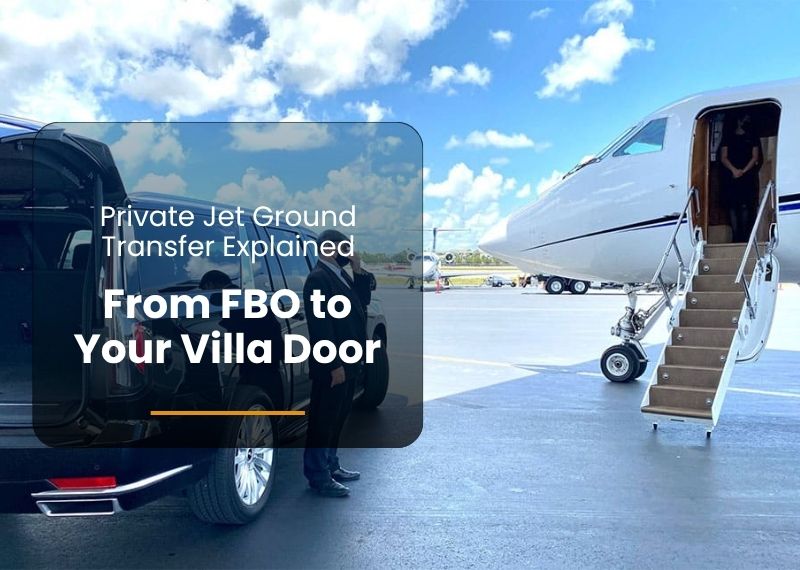
Most conversations about private aviation stop at the runway. People talk about aircraft categories, cabin space, and flight time, then assume the rest of the journey simply takes care of itself. In reality, the gap between wheels touching down and stepping through your villa door is its own operation, with its own logistics, its own timing pressures, and its own room for things to go wrong if nobody is managing it properly.
This is the private jet ground transfer chain. It starts the moment your aircraft taxis to the ramp and doesn’t end until you’re standing in your accommodation with your luggage beside you. Understanding how it works helps you ask the right questions when booking a charter, and it explains why FBO to villa logistics deserve as much attention as the flight itself.
Stop scrolling. Start planning.
Explore private jet options and find a flight that fits your destination and schedule.
The First Handoff Happens at the FBO
When a private jet lands, passengers don’t move through a commercial terminal. They deplane directly at a Fixed Base Operator, the private facility that handles everything from fueling and ground handling to passenger reception. This is where the ground transfer chain actually begins.
A good FBO concierge team is tracking your flight before you land. They know your estimated arrival time, they’ve been briefed on your preferences, and they coordinate directly with whoever is providing your ground transportation so a vehicle is positioned and ready, not scrambling to arrive after you’ve already deplaned. Some FBOs even allow tarmac access for the chauffeur, meaning the car meets you at the aircraft steps rather than at a separate pickup point.
This early coordination matters more than most travelers realize. If the FBO concierge and the chauffeur service aren’t talking to each other, you end up waiting on the ramp while someone makes a phone call, which defeats much of the point of flying private in the first place.
Why Chauffeur Coordination Isn’t Just a Car and a Driver
A private jet chauffeur service is often mistaken for a slightly nicer taxi. It isn’t. Behind a smooth pickup is a sequence of decisions that started well before your flight departed.
Reputable operators begin monitoring your flight roughly a day or two out, watching for schedule changes, weather delays, or route adjustments. As your arrival window narrows, they refine vehicle positioning, usually dispatching thirty to forty five minutes ahead of your expected landing so the car is already on site rather than en route.
Vehicle selection matters too. A chauffeur company serving private aviation clients typically maintains a fleet suited to different party sizes and luggage volumes, from an executive sedan for a solo traveler to a larger SUV or Sprinter van for a family arriving with ski equipment or extra bags. Getting this wrong, sending a car too small for the group, creates delays that cascade through the rest of the transfer.
The chauffeur’s job on the ground also extends beyond driving. Trained drivers know the FBO’s layout, understand where to park, and are briefed on any security or discretion requirements for the client. For high profile travelers, this can include managing entry points and minimizing visibility, which is a meaningfully different skill set than standard airport pickup.
Customs, Documentation, and the Quiet Steps Nobody Talks About
On international arrivals, there’s a layer of the transfer chain that happens almost invisibly: customs and immigration processing. Many FBOs offer expedited clearance for private aviation passengers, sometimes processing documentation while you’re still in the lounge rather than making you queue.
Good ground transfer coordination accounts for this. The chauffeur and FBO staff typically stay in contact so the vehicle isn’t sitting idle for an unpredictable clearance window, and so any customs delay is communicated back to whoever is coordinating the rest of your day, including villa staff waiting on your arrival.
Stop scrolling. Start planning.
Explore private jet options and find a flight that fits your destination and schedule.
From Tarmac to Villa: Where the Chain Actually Gets Tested
The FBO handoff and the chauffeur pickup are the visible parts of the journey. The less visible part is what happens between the airport and your final destination, especially when that destination is a private villa rather than a hotel with a fixed check in desk.
Villa logistics introduce variables that hotels don’t have. There may be a gate code to coordinate, a property manager waiting at a specific time, or a remote location where GPS routing isn’t reliable. A transfer service experienced in FBO to villa logistics will have confirmed the drop off details in advance: exact address, access instructions, contact person on site, and a realistic drive time that accounts for local road conditions rather than a generic map estimate.
This is also where communication between all parties earns its keep. If your flight lands early, does the villa know to have someone ready? If there’s a delay, has the chauffeur been told to hold rather than arrive and wait outside? These are small details, but they’re the difference between a seamless arrival and standing outside a locked property at midnight with no one to call.
Choosing a Transfer Partner Who Understands the Whole Chain
Not every ground transportation company is built for this. Some are excellent standard chauffeur services that treat an FBO pickup like any other airport run, without the flight tracking, tarmac coordination, or villa specific planning that private aviation clients actually need.
When evaluating a provider, it’s worth asking a few direct questions. Do they track flights in real time or rely on a fixed pickup slot? Do they have experience with tarmac access at your specific FBO? Can they coordinate directly with villa staff or a property manager rather than leaving that to you? The answers tend to reveal quickly whether a company understands the full transfer chain or only the airport portion of it.
Booking the Journey as One Continuous Experience
The reason this chain matters is simple. Flying private removes friction from the air travel portion of your trip, but that value gets undermined if the ground portion is disorganized. When you’re arranging a charter, whether directly or through a broker like Villiers Jets, it’s worth asking whether ground transfer coordination is included or needs to be arranged separately, and whether the operator has relationships with FBOs and chauffeur services at your specific destination.
A private jet charter that’s genuinely door to door treats the flight and the ground transfer as one coordinated experience rather than two separate bookings that happen to occur on the same day. That’s ultimately what the private jet ground transfer chain is meant to deliver: a landing that flows directly into your villa arrival without a single awkward gap in between.