
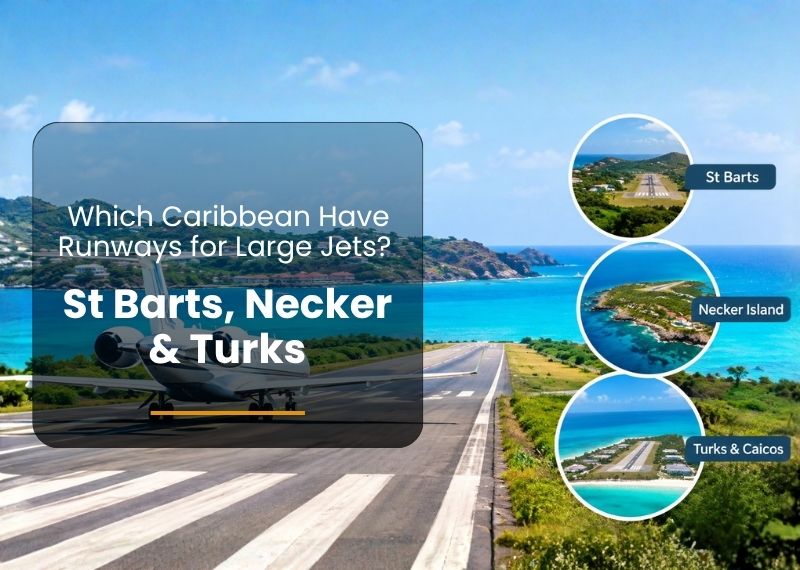
Ask ten people which Caribbean islands can handle a large private jet, and most will guess wrong. The islands with the biggest reputations for luxury, St Barts and Necker among them, are often the ones with the shortest or non-existent runways. Meanwhile, a working island like Providenciales in the Turks and Caicos quietly has one of the longest paved runways in the entire Eastern Caribbean.
If you’re planning a trip on a private jet Caribbean islands trip and picking a destination based on the aircraft you’re flying, runway length isn’t a footnote. It decides whether you land on the island you booked, or land somewhere else entirely and finish the journey by boat or helicopter.
St Barts: the famous runway that can’t take a large jet
Gustaf III Airport, known locally as St Jean Airport, is the only airport on St Barthélemy. It’s one of the most photographed runways in the world, mostly because of how short it is. The strip runs about 2,100 feet, roughly 650 meters, and ends almost at the edge of St Jean beach. Pilots have to drop steeply over a hill just before touchdown, which is why the airport has become something of a spectacle for aviation enthusiasts.
That length rules out anything beyond small turboprops and a narrow list of light jets with true short-field performance. A Gulfstream, a Global, even most midsize business jets, simply can’t operate there safely. Anyone flying to St Barts on a larger aircraft lands instead at Princess Juliana in St Maarten, about 7,500 feet of runway, and completes the last leg by a smaller charter plane, helicopter, or ferry.
Stop scrolling. Start planning.
Explore private jet options and find a flight that fits your destination and schedule.
Necker Island: no runway of its own at all
This one surprises people the most. Necker Island, Richard Branson’s private retreat near Virgin Gorda in the British Virgin Islands, doesn’t have an airstrip. Guests fly into Beef Island, home of Terrance B. Lettsome International Airport on Tortola, or into the smaller Virgin Gorda Airport at Taddy Bay, and then take a boat or helicopter transfer the rest of the way.
Virgin Gorda’s runway is short, gravel-surfaced in parts of its history, and has been undergoing repeated maintenance and resurfacing work. It’s built for light aircraft only. Beef Island is the more realistic gateway for anyone chartering a larger jet toward Necker, since it has the longer, paved runway that BVI officials have been pushing to extend for years to support bigger commercial and private traffic.
So when someone searches for the runway length at Necker, the honest answer is that there isn’t one. The island itself was never built for fixed-wing arrivals.
Turks and Caicos: the island that quietly does it right
Providenciales International Airport, sometimes listed under its newer name, Howard Hamilton International Airport, is the opposite story. Its single runway stretches roughly 9,200 feet, one of the longest in this part of the Caribbean. It was extended in phases through the 1980s, then again in 2011, specifically to bring it up to a standard that could handle heavy commercial jets like the Boeing 777, alongside the private charter traffic that Provo attracts.
For a Gulfstream G650, a Falcon 7X, or a Global 5500, Providenciales is essentially unrestricted. This is a big part of why Turks and Caicos has become such a natural fit for large private jets heading into the Caribbean. The runway simply isn’t a limiting factor the way it is on so many of the smaller, more exclusive islands.
Where else large jets can actually land
A handful of other islands have runways built to a similar standard. Antigua’s V.C. Bird International Airport runs close to 10,000 feet. Princess Juliana in St Maarten, despite its own famous low approach over Maho Beach, still offers about 7,500 feet, enough for most heavy jets. Barbados and San Juan follow the same pattern, longer commercial-grade runways built for scheduled international service that happen to also serve large private aircraft well.
On the other end, islands like Anguilla, at just under 5,500 feet, Nevis, at around 4,000 feet, and Mustique, barely over 3,200 feet, sit firmly in light jet and turboprop territory. These runways were built for the volume and aircraft types the islands actually see day to day, not for anything in the heavy jet class.
Why this actually matters when planning a trip
The pattern across the Caribbean is consistent. The islands built around scale and commercial air traffic, Providenciales, Antigua, St Maarten, San Juan, have the runway length to match. The islands built around privacy and exclusivity, St Barts, Necker, Mustique, deliberately kept their airstrips small, and in Necker’s case skipped one entirely, because that scarcity is part of what makes them feel remote.
Stop scrolling. Start planning.
Explore private jet options and find a flight that fits your destination and schedule.
For anyone chartering a jet, this means the aircraft choice and the destination choice have to be made together, not separately. A client set on a heavy jet can’t simply request St Barts and expect a direct landing. The realistic plan is flying into a long-runway hub nearby and finishing the trip on a smaller aircraft or by sea. That kind of routing knowledge is exactly what separates a smooth Caribbean charter from one that runs into a surprise on arrival day, and it’s worth building into any itinerary before the aircraft is even confirmed.